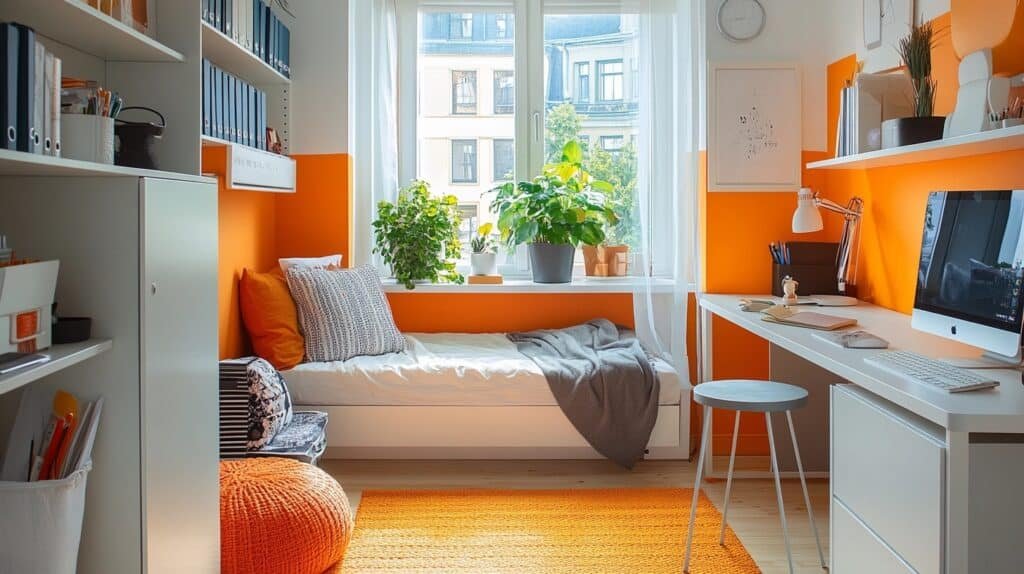
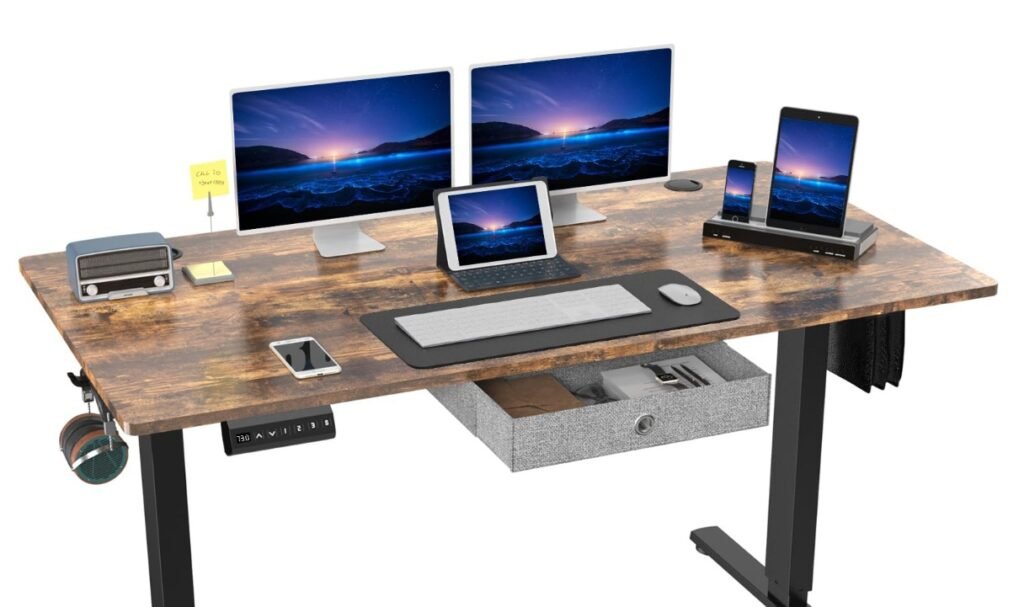
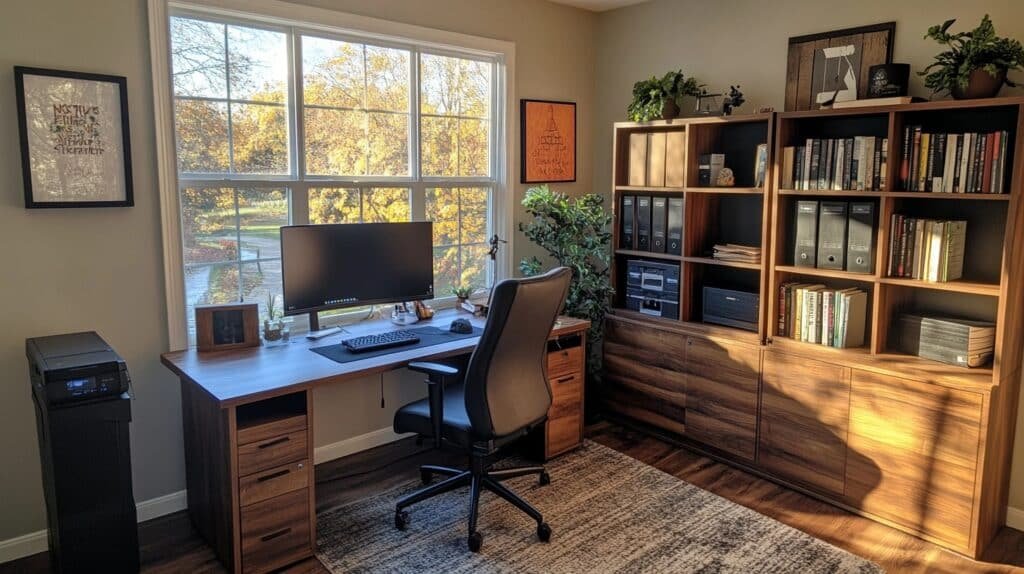
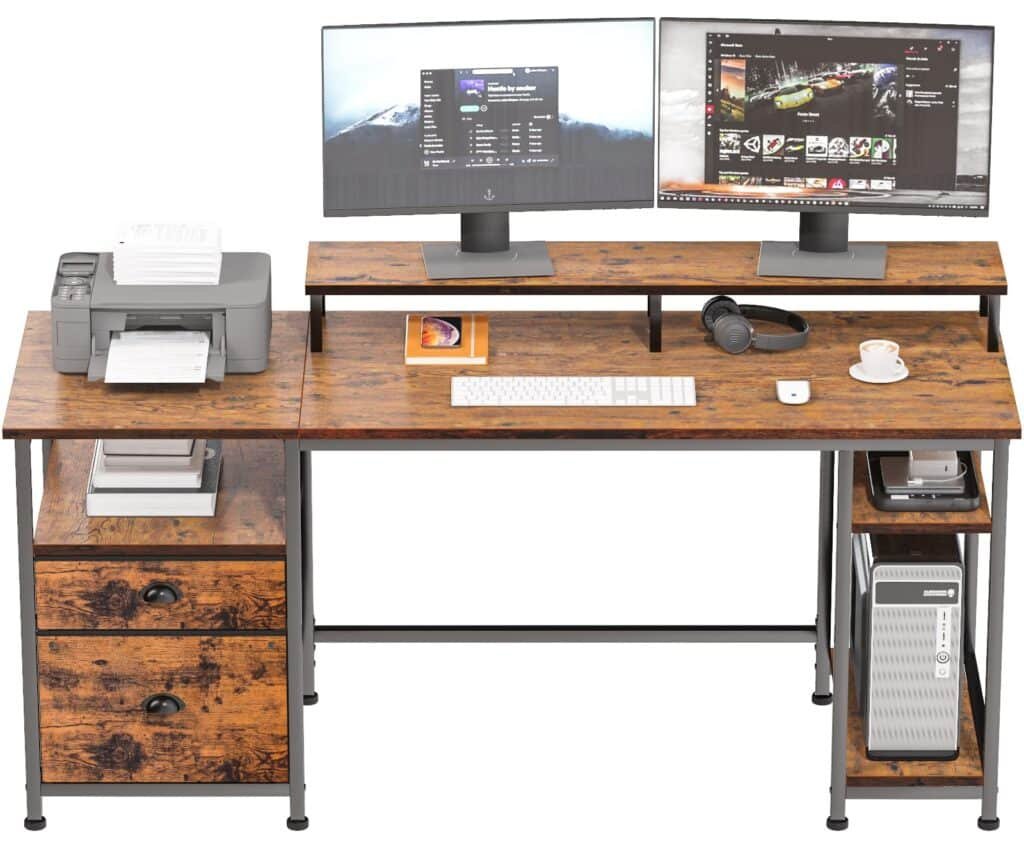
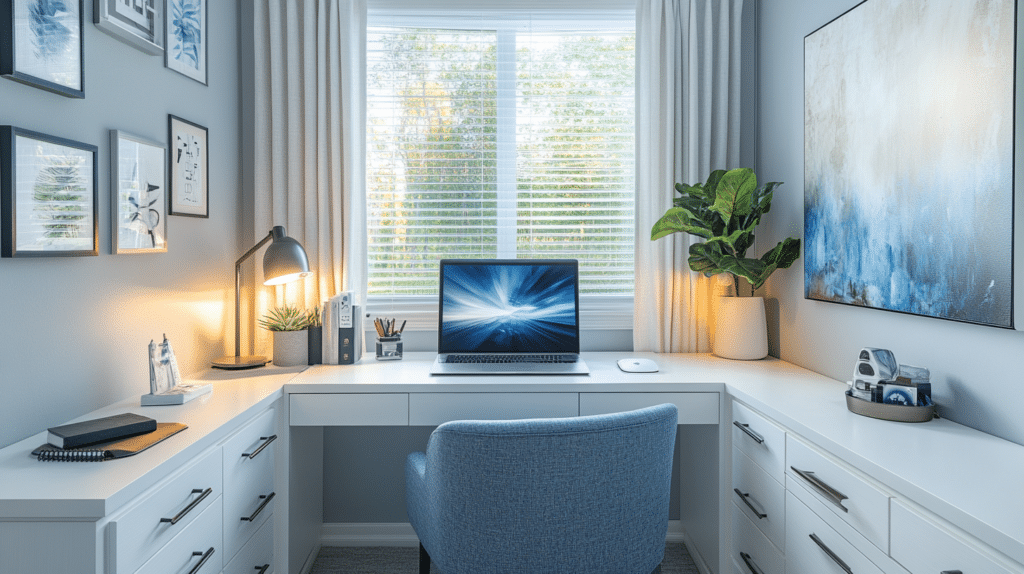
Home office ideas for women get reduced to two extremes online: either everything’s blush pink with a “boss babe” sign, or it’s a sterile gray cube that could belong to anyone. Neither works if you’re in that room eight hours a day. I’ve built three home offices over the past six years — a closet conversion in a one-bedroom rental, a corner of my living room, and now a spare bedroom — and the version that finally stuck was the one that stopped trying to look like a Pinterest board and started functioning like an actual workspace with good taste layered on top.
Here’s what I learned building all three, including the chair I returned twice and the shelf that sat empty for a month because I didn’t know what to put on it.
What This Style Actually Is
The look isn’t “girly office.” It’s closer to soft glam meets modern minimalism — clean lines, a warm neutral base, and just enough texture and color that it doesn’t feel borrowed from a corporate lobby. Think warm white walls, a wood or white desk, brass or gold hardware, and one piece of art that actually means something to you instead of a generic “hustle” print.
Who this is for: remote workers, freelancers, small business owners, students — anyone who wants a space that feels put-together on a video call and doesn’t make them want to leave the second they sit down.
Where it works: a spare bedroom, a converted closet, a corner of your bedroom or living room, even a landing at the top of the stairs if that’s what you’ve got. My first version was 28 inches of desk depth wedged into a closet with the door removed. It worked because I stopped trying to fit a full-size desk in there and bought one built for the space instead.
Time and cost, realistically:
– A weekend refresh (new lighting, art, a rug, storage bins) runs $150–$500 and takes a day or two.
– A proper setup — desk, ergonomic chair, shelving, lighting — lands around $600–$2,500 depending on how much you’re replacing versus keeping.
– Built-ins or custom storage push past $3,000, and honestly, I’d only go there if you’re staying in the house long-term. I did not do this in a rental, for obvious reasons.
The Pieces That Actually Make It Work
The desk. Keep it simple. A white or light wood writing desk, a curved desk, or a corner desk if you’re tight on space. The mistake I made the first time: I bought an ornate desk with a scalloped edge because it was “so pretty” online. It fought with everything else I put near it. A clean-lined desk is your blank canvas — add the personality through what sits on top of it, not the desk itself.
The chair. This is where I wasted money. I bought a velvet accent chair on wheels because it looked incredible in photos. Three weeks in, my lower back hated me. I returned it and got an upholstered ergonomic chair with real lumbar support in a boucle fabric instead — same soft, curvy look, but I can sit in it for six hours without wanting to lie on the floor. If you only spend real money on one thing, spend it on the chair.
Storage. Floating shelves, a couple of closed cabinets, and baskets for the stuff you don’t want visible — cords, extra paper, the printer. I use two woven baskets under my desk that hide literally everything ugly about working from home. Vertical file holders and a small pegboard handle the rest. The goal is that nothing on your desk looks like “office supplies” unless it’s actively being used.
Lighting. Don’t rely on the overhead fixture. Layer it:
– Natural light — put the desk near a window if you can. I moved mine from an interior wall to face a window and it changed how the whole room felt, not just how well I could see.
– A task lamp on the desk for close work.
– A floor or table lamp somewhere else in the room for evening ambiance, so the space doesn’t feel like an interrogation room after 5pm.
Wall decor. This is your personality slot. A gallery wall, a large piece of abstract or botanical art, a vision board, a pin board with fabric stretched over cork — pick one dominant feature instead of five small scattered ones. My office has one large botanical print above the desk and a small cork board off to the side for actual working notes. That’s it. That’s the whole wall strategy, and it’s enough.
Textiles. A rug under the desk area (even a small 4×6 one) instantly makes the space feel finished instead of like furniture dropped into an empty room. Add a throw blanket on a nearby chair if you have one, and linen curtains if the window’s bare. This is what keeps an office from feeling like a tech showroom.
Plants. One real plant does more than five fake ones. I have a pothos on the shelf that I’ve kept alive for two years, which for me is a personal record, and a small snake plant in the corner that needs almost no attention. If you kill everything green, a couple of good faux stems in a ceramic vase still beats bare shelf space.
Optional Touches Worth Considering
If you want more of that soft-glam feel, add it in small, controlled doses:
– Brass or gold pen cup, picture frames, or drawer pulls
– A small mirrored tray to corral desk odds and ends
– Woven or rattan accents — a blind, a basket, a chair back — for warmth
– Seasonal swaps: fresh flowers and lighter linens in spring/summer, a heavier throw and warmer-toned lamp in fall/winter
None of these need to happen at once. My office has evolved over two years, not two weekends.
How to Actually Put It Together
Start with the big stuff first. Desk, chair, storage, rug — in that order. Everything else is easier to place once those anchors are down. I made the mistake of buying art and accessories before I even had my desk positioned, and half of it didn’t work once the room was actually set up.
Pick your palette before you shop. Go with 2–3 main colors plus one accent metal — for example, warm white, taupe, and blush, with brass hardware throughout. Repeat that metal and those tones in at least three places (lamp, frames, drawer pulls) so the room feels intentional instead of assembled from random sale finds.
Style the desktop with restraint. My rule: five items max. A lamp, a small tray, a notebook holder, one plant, one decorative object. Everything else goes in a drawer or a basket. A cluttered desk undercuts every other design choice you made in the room.
Give the room one focal point. Whether that’s a gallery wall, an oversized art print, or a genuinely great chair, let one thing carry the visual weight. Trying to make everything a “moment” is what makes a lot of feminine office decor tip into busy.
Balance soft with structure. Pastels and curves need something to ground them — black picture frames, a dark wood accent, matte black hardware. My blush and cream palette didn’t feel adult until I added a black-framed mirror and swapped my gold accessories for a mix of gold and matte black. That contrast is doing more work than people give it credit for.
Mistakes I’d Steer You Away From
– Going all-pink, all the time. Feminine doesn’t mean pastel on every surface. Use color as an accent — pillows, one wall, a few accessories — not the whole room.
– Choosing the pretty chair over the comfortable one. Learn from my velvet chair disaster. Sit in it for at least ten minutes before buying, or check the return policy closely if you’re buying online.
– Overloading the desk. If you can’t see the desk surface, you have too much on it.
– Skipping storage. Cords, paperwork, and printers don’t decorate themselves away. Plan for concealed storage before you start adding pretty things.
– One light source only. Overhead lighting alone makes everything flat and a little sad by late afternoon. Layer it.
– Oversized furniture in a small room. A huge desk in a small office kills circulation. Measure your space — you want at least 24–36 inches of desk depth and enough clearance to push your chair back fully without hitting a wall.
Keeping It Feeling Fresh Without Redoing Everything
Once the bones are right, updates are cheap and fast. Swap the art print seasonally. Add fresh flowers when they’re in season. Change a throw pillow or two. Update the basket on your shelf. None of this costs more than $50 and it keeps the room from going stale.
For bigger but still manageable updates, a new rug, better lighting, or floating shelves refresh the whole feel without a full redo.
And if you want to push the aesthetic in a different direction later, the bones of this style flex easily:
– Coastal-feminine: swap in pale blue, whitewashed wood, breezy linen curtains
– Boho-feminine: more rattan, more plants, layered warm textures
– Classic-feminine: built-in shelving, traditional framed art, deeper wood tones
My own office has shifted twice in two years without me buying a single new piece of furniture — just different art, a different rug, and swapping brass for a mix of brass and black. The desk and chair stayed exactly the same, because those were the two things I got right the first time I stopped shopping for pretty and started shopping for right.
For another angle on this, my womens home office guide covers the same space from a different starting point.