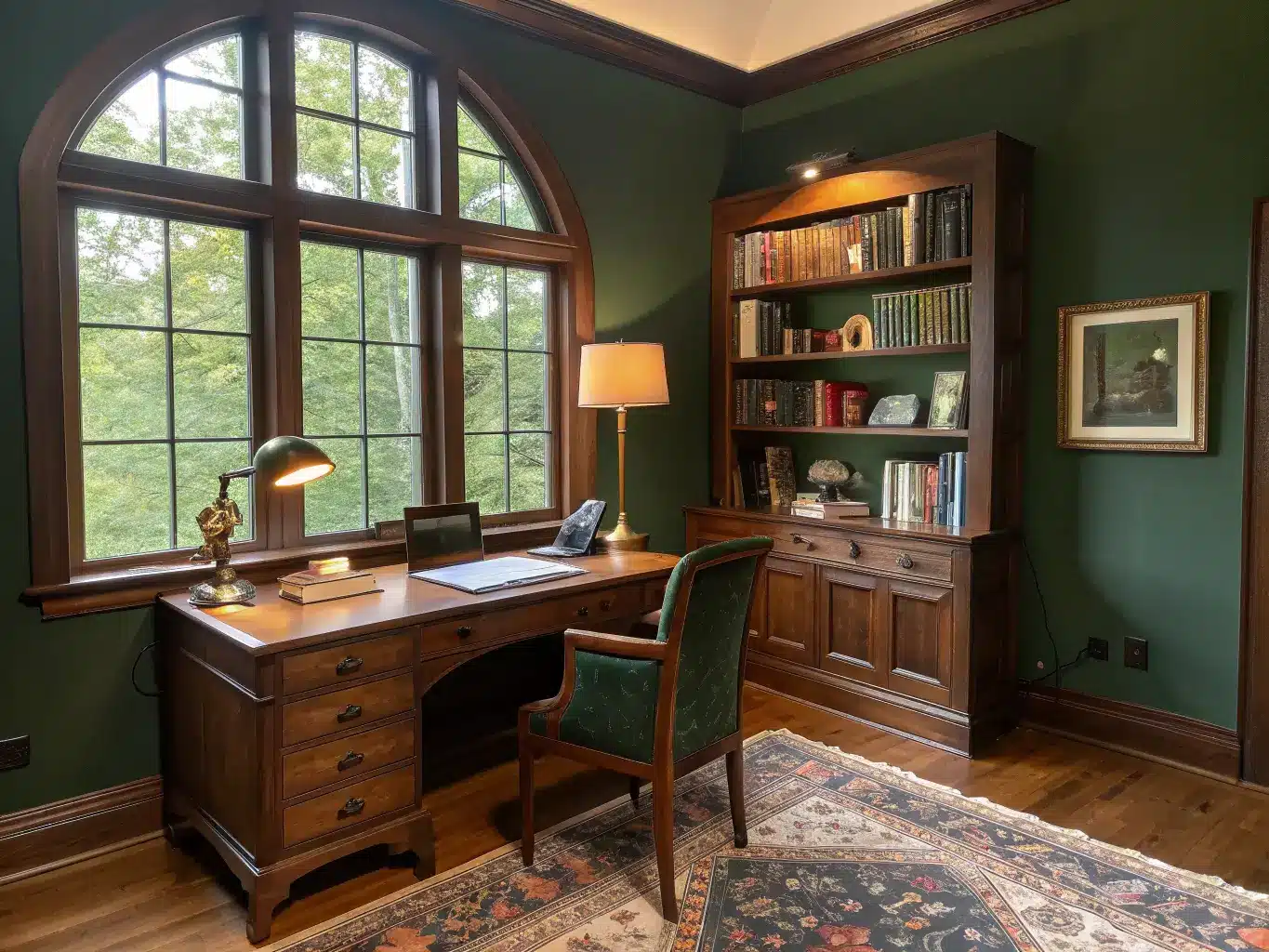
I painted my study forest green on a Sunday afternoon, stood back to admire it, and immediately hated it. Not the color — the room. It looked like a green box with a desk in it. It took me another three weeks of trial and error, one regrettable trip to a Halloween store for a plastic skull I returned the next day, and a lot of secondhand bookstore visits before it actually felt like the room I’d been picturing: warm, lived-in, a little theatrical, like someone had been writing their dissertation in there for a decade.
If you’re searching for dark academia study room ideas, you’re probably picturing that exact thing — old libraries, brass lamps, leather chairs, walls of books. It’s a great look, and it’s very achievable. But it’s also easy to get wrong in a way that leaves the room feeling either empty or like a costume. Here’s how I’d build it if I were starting over, knowing what I know now.
What Dark Academia Actually Is (and Isn’t)
Dark academia borrows from old university halls, historic private libraries, and that specific mood of a rainy afternoon spent reading by lamplight. Think Collegiate Gothic architecture meets a well-loved secondhand bookshop, not a haunted mansion.
The palette is forest green, oxblood, burgundy, walnut brown, charcoal, ink navy, and aged cream — dark, but never just black. Materials lean on dark-stained wood, leather, brass, velvet, tweed, and linen. It’s scholarly, not spooky, which is the single biggest thing people get wrong (more on that below).
Who this is for: readers, writers, remote workers, grad students, anyone who wants their desk to feel like a retreat instead of a corporate afterthought.
Where it works: home offices, spare bedrooms, dorm rooms, library nooks, converted closets. I’ve seen it done beautifully in a space barely 6 by 8 feet — the density of the styling matters more than square footage.
Time, Cost, and Skill Level — What to Actually Expect
Timeline: A light refresh — new lamp, a stack of thrifted hardcovers, a throw blanket — is a weekend project. If you’re painting, adding shelving, or replacing furniture, budget 1 to 3 weeks, because this style is built in layers and rushing it shows.
Budget: You can get a convincing starter version going for around $100 — a $30 secondhand desk lamp, a $20 haul of hardcovers from a used bookstore, a $40 wool throw. A fuller setup with a real desk, upholstered chair, bookshelf, rug, and layered lighting typically runs a few hundred dollars into the $1,000+ range, depending heavily on whether you thrift or buy new.
I did mine for under $600 total, and the single most expensive thing I bought was the chair ($220, secondhand, worth every cent).
Skill level: Beginner-friendly if you’re just styling. If you’re installing picture lights, paneling, or built-in shelving, that’s an intermediate-to-advanced weekend project — hire it out if you’re not confident with a stud finder and a level.
Season: Works year-round, but it genuinely comes alive in fall and winter, when the low light outside matches the low light you’re creating inside.
The Essential Pieces (Get These Right First)
Everything else in the room is decoration. These are structure.
– The desk. Solid wood — walnut, mahogany, or aged oak. Skip anything with a laminate top or thin metal legs; it reads modern-office instantly. If you can find one with a green leather inlay, that’s the dream, but a plain solid-wood desk with the right accessories gets you 90% of the way there.
– The chair. This is the signature piece. A leather captain’s chair, a tufted wingback, or a club chair in cognac or oxblood does more visual work than almost anything else in the room. I bought mine off Facebook Marketplace from someone redoing their law office. It had a small crack in the leather arm. I left it — it looks like it’s been there for decades, which is the whole point.
– Bookshelves. Go tall. Floor-to-ceiling if your room allows it. Books aren’t storage here, they’re the wallpaper. A short bookshelf with a few paperbacks scattered on it will never read as dark academia — you need volume.
– Lighting. A brass banker’s lamp with a green glass shade is close to non-negotiable — it’s the single most recognizable object in this style. Pair it with at least one floor lamp or secondary table lamp. One overhead fixture will never carry this room.
– Books as decor, seriously. Thrifted hardcovers, clothbound classics, anything with real wear on the spine. Stack some flat, shelve some upright, let a few lean against each other slightly off-kilter. Uniform decor books (the fake kind sold in sets) look exactly as fake as they are.
– Wall decor. Framed classical art, a vintage map, an antique-style clock, an old mirror. I found a water-damaged botanical print at an estate sale for $8, reframed it myself for $15, and it’s the thing everyone asks about.
– Textiles. A Persian-style or faded oriental rug grounds the whole room. Add a wool throw over the chair arm and one velvet or tweed pillow.
– Scholarly objects. A globe, a small bust, an hourglass, a leather journal, a fountain pen on the desk. These are cheap, thrifted, and they’re what push the room from “dark room” to “someone’s study.”
Optional Layers That Take It Further
Once the essentials are in place, these add depth:
– Wood paneling or half-wall trim — gives an architectural, old-university feel, but it’s a bigger project. Worth it if you’re staying in the space long-term.
– Plaid or dark patterned wallpaper on one wall — high impact, especially behind the desk.
– Heavy green or burgundy drapery to frame windows and reinforce the palette.
– Dried botanicals — a bundle of eucalyptus or pressed florals softens the room without breaking the mood. Skip anything bright or tropical-looking.
– Unlacquered brass or antique bronze accents — bookends, drawer pulls, a letter opener. These keep the room from going flat and monochrome.
– A mirror near a lamp — bounces light around and stops the room from feeling like a cave, which is a real risk with this palette.
How to Actually Put It Together, Step by Step
1. Clear the modern clutter first. Bright plastic bins, a sleek ergonomic desk chair, visible charging cables — all of it breaks the illusion. Get it out before you style anything.
2. Place the desk near a window. You want daylight during work hours and a lamp taking over at dusk. This one placement decision does a lot of the atmospheric heavy lifting.
3. Get storage in before decor. Shelving is structure, not accessory. Decide where the books live before you buy a single knickknack.
4. Set your lighting plan before you style anything else. I mean this literally — plug in your lamps, turn off the overhead light, and see how the room feels before you hang a single print. Keep bulbs at 2700K or lower. Anything cooler or brighter kills the mood instantly, no matter how good your furniture is.
5. Choose one dark color, one wood tone, one metal finish, and stop there. I used forest green, walnut, and brass. That’s it. Every piece I’ve added since has had to fit into that trio, which is why the room feels cohesive instead of like a prop closet.
6. Layer in books, then objects, then textiles, in that order. Books first because they set the density of the room. Objects second because they need shelf space that’s already partially full. Textiles last because they’re the easiest to edit later.
Common Mistakes (I Made Most of These)
– Harsh white lighting. My first mistake. I had a daylight-temperature bulb in that banker’s lamp for two weeks before I realized it was undoing everything. Swap to warm bulbs immediately — it’s a $6 fix that changes the entire room.
– Going too sparse. A dark academia room with three books and empty shelves looks unfinished, not minimalist. This style wants density.
– Cool or glossy finishes sneaking in. A chrome desk lamp or a glossy black picture frame will quietly fight everything else in the room. Check your metals and finishes against your three-material rule.
– Making everything black. Black alone reads gothic and a little flat. You need the oxblood, the brass, the cream-colored book pages, the warm wood — that’s what gives it depth instead of just darkness.
– Turning it into Halloween decor. This was my skull mistake. Skulls, fake cobwebs, and horror-movie props push this into a different aesthetic entirely. Dark academia is a library, not a haunted house.
– Forgetting the room has to function. A gorgeous chair that’s uncomfortable to sit in for two hours, or lighting too dim to actually read by, defeats the purpose. Test the room by working in it for a real afternoon before calling it done.
Keeping It Cohesive Over Time
Stick to your palette religiously. Every new piece — even a $5 thrift store find — should fit into your green/oxblood/brown/brass/cream world. This is the easiest way to keep a room that’s built up over months from looking like a random collection.
Reuse materials across pieces. If your desk is walnut, look for a walnut-framed mirror later. If your lamp is brass, your drawer pulls should be too. Repetition is what makes a room feel designed instead of accumulated.
Rotate density, not direction. Swap which books are facing out, change up the prints seasonally, move the globe to a different shelf. Don’t chase a new aesthetic every few months — refresh within the one you’ve built.
Leave a little breathing room. I learned this the hard way when my shelves got so packed the room started to feel chaotic instead of scholarly. One or two open surfaces let the eye rest.
Seasonal and Budget Refreshes
Fall/winter: Add plaid throw pillows, more candles, a richer wool blanket, darker florals if you keep any greenery. This is the season the style was basically made for.
Spring/summer: Lighten slightly — dried botanicals instead of heavy greenery, parchment-toned accents, curtains open more often. Keep the bones the same; just let more light in.
Budget moves that punch above their price:
– Thrifted hardcovers, $1–3 each, in bulk from used bookstores or library sales
– A $15 secondhand frame with a new print inside
– A resin bust instead of stone or bronze — nobody can tell from three feet away
– One good lamp instead of five mediocre ones
Quick high-impact swaps: a new lampshade, a plaid or Persian-style rug, a denser stack of books on the desk, a pair of brass bookends. Any one of these, done well, can shift a room noticeably in an afternoon.
Dark academia rewards patience more than most styles — it’s not a one-shopping-trip aesthetic. But it’s also forgiving. Once your palette and materials are locked in, almost anything old, wooden, leather, or brass that crosses your path will probably fit right in.
For another angle on this, my study room aesthetic guide covers the same space from a different starting point.