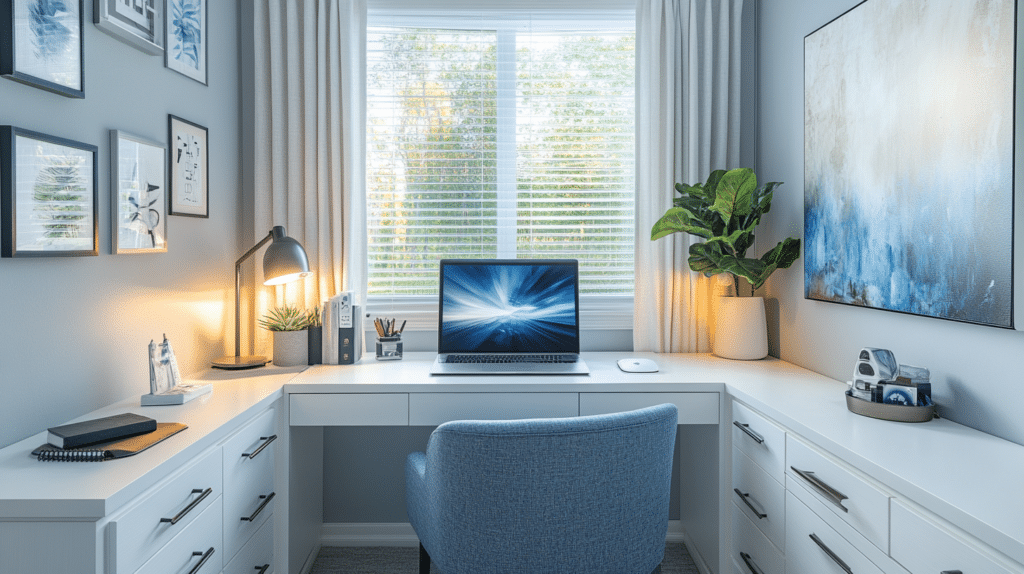
I spent two years working from a corner desk shoved against a beige wall, and every video call looked like I was dialing in from a storage closet. When I finally redid the space — an 8×10 spare room off our kitchen — I went too far the other direction first. Gold everything, a velvet chair that looked like it belonged in a hotel lobby, and a chandelier that was honestly too big for the ceiling height. It took a full redo to figure out what an elegant home office actually needs: restraint, good materials, and light that does some of the styling work for you.
Here’s what I’d tell you if you were standing in my old beige corner right now.
What “Elegant Home Office” Actually Means
It’s not glam for glam’s sake. Think modern classic with a little quiet luxury — warm neutrals, one or two rich materials, furniture with actual presence instead of flat-pack anonymity. It should look put-together on a Zoom call and feel calm enough to sit in for six hours straight.
This style works for anyone who wants a workspace that reads as intentional — not a corner someone forgot to finish decorating. And you don’t need a dedicated room. I’ve seen it done well in:
– A spare bedroom
– A finished basement corner
– An attic nook with a slanted ceiling
– A wide hallway alcove (if storage is handled right)
Space-wise, 8×10 feet works if you’re smart about built-ins. 10×13 feet gives you room for a floating desk plus real cabinetry, which is the setup I’d pick if you have the choice.
Timeline: a weekend if you’re just restyling what you own. Two to three weeks if you’re adding molding, wallpaper, or built-ins.
Budget: I spent about $1,800 on my refresh — desk, chair, lamp, rug, art. If you want built-ins and a proper light fixture, budget $3,000–$10,000. Either way works. The style isn’t about spending more, it’s about spending on the right three things.
The Pieces That Actually Carry the Room
The desk is your hero piece — treat it that way
Don’t buy a desk that could also be a kid’s homework table. I made this mistake first: a $200 particleboard desk with a white laminate top. It looked fine in photos and cheap in person within a month.
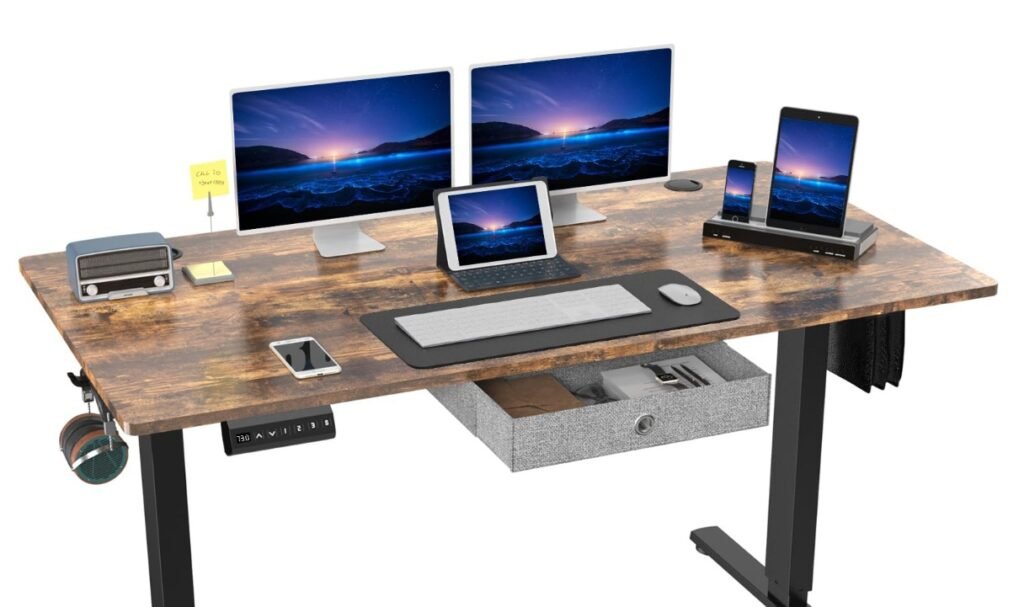
Go for a desk with real material presence — walnut, ebony-stained wood, white lacquer, or a marble-look top. You don’t need it to be huge. A 48–60 inch desk is plenty for one monitor and a laptop. Mine is a 54-inch walnut desk with brass legs, and it’s the single item that makes the room look expensive.
Your chair needs to work as hard as it looks good
The velvet chair I mentioned? Beautiful for about three hours of sitting, then my back gave up. Elegant doesn’t mean uncomfortable. Look for:
– Real lumbar support
– Height adjustability
– Upholstery that still reads refined — leather, performance velvet, or a tailored swivel design
I replaced mine with a leather task chair that has brass-tone casters. It photographs just as well and I can actually work in it.
Lighting is not optional — and one fixture isn’t enough
This is the mistake I see most. People buy one nice lamp and call it done. Layered lighting is what separates an elegant office from a beige box with good furniture:
– Task lighting: a real desk lamp, ideally brass or a matte black finish with an articulating arm
– Ambient lighting: a pendant, small chandelier, or flush mount overhead
– Accent lighting: wall sconces flanking a bookshelf, or a picture light over art
My overhead is a small brass chandelier, scaled for an 8-foot ceiling — 18 inches wide, not the 30-inch one I originally bought and had to return because it looked like it belonged in a dining room.
Storage: hide almost everything
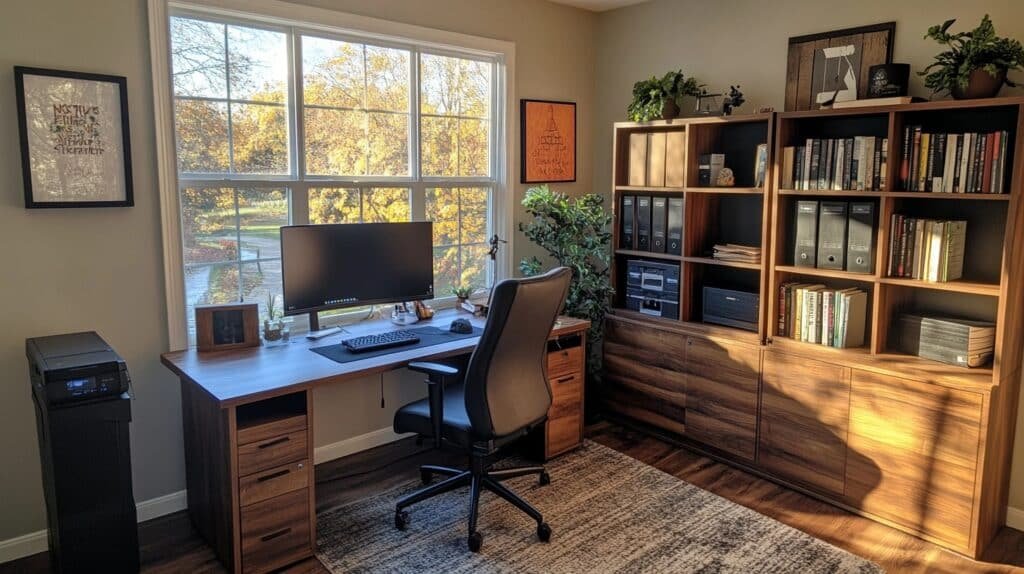
Printers, cables, extra paper, old cords — none of it should be visible. Closed storage is what keeps the “elegant” look intact after week one of actual work. Tall bookshelves with a mix of closed cabinet doors on the bottom and open shelving up top give you both function and display space.
I keep my printer in a cabinet with a pull-out shelf. It’s the least glamorous sentence in this article and also the reason my desk stays clear.
The rug, the drapes, the small stuff
– Rug: wool or a wool-viscose blend, low pile, big enough that your desk chair sits on it even when pushed back. Mine is a 6×9 in warm ivory with a subtle diamond pattern — it softens the hard floor and quiets the room.
– Window treatment: tailored drapes or sheers. I went with linen drapes in a soft taupe — enough to soften the window without blocking the light I need for calls.
– Accessories: one marble tray, a brass lamp, a stack of real books (not staged decorative ones — actual books I read), a small ceramic vase, one piece of framed art. That’s it. Stop there.
How to Actually Put It Together
Pick your palette before you buy anything. This is the step I skipped the first time, which is how I ended up with gold, brass, AND chrome in the same room. Pick one metal, one wood tone, and a two-to-three color palette. My combo: walnut, brass, and warm white with a sage accent in the art and one throw pillow on the reading chair. That’s the whole palette. Everything gets checked against it before it enters the room.
Layer texture before you add color. Elegant offices lean on contrast between materials — smooth marble against nubby linen, warm wood against cool brass — more than on a rainbow of hues. If your room feels flat, it’s probably not missing color. It’s missing texture variation.
Give the room one focal point, not five. Mine is the desk-and-chandelier combo, viewed from the doorway. Everything else — the rug, the shelving, the drapes — supports that focal point instead of competing with it.
Place the desk for light first, camera second. I put my desk perpendicular to the window, not facing it (facing a window means you’re backlit and invisible on calls) and not with your back to it (you get glare and blown-out video). Perpendicular gives you soft, even light on your face. Behind me, for the camera: a section of the bookshelf, styled sparse, plus one piece of art. That’s your whole Zoom background problem solved without buying a “Zoom room” kit.
Where to Spend, Where to Save
Spend on:
– The desk (it’s the visual anchor and gets touched daily)
– The chair (comfort failures ruin the whole room’s usability)
– One statement light fixture
Save on:
– Bookshelf styling objects — thrift stores and HomeGoods clearance sections have real brass candlesticks and stone bookends for a fraction of West Elm prices. My marble tray was $14 at a thrift store; a similar one online runs $65.
– Wall treatment — peel-and-stick grasscloth wallpaper or picture-frame molding kits from a hardware store get you 80% of the custom built-in look for a fraction of the cost.
– Drapery — ready-made linen panels, hemmed yourself or by a tailor for $15–20, look nearly identical to $200 custom versions once they’re up.
Mistakes That Undercut the Look
– Overcrowding surfaces. Every object competing for attention makes the whole room read as cluttered, not curated. If you add a new object, remove one.
– Skipping storage planning. A gorgeous desk with cables and paper piled on top looks worse than a plain desk that’s clean. Storage isn’t an afterthought — plan it before you buy decor.
– Under-lighting the room. One ceiling fixture, no task lamp, is the fastest way to make an expensive room look like an unfinished one.
– Choosing looks over function. If the chair hurts your back or the desk is too short for your keyboard height (aim for 28–30 inches from floor to desktop), you’ll stop using the room the way you designed it to be used.
– Mixing too many styles at once. Industrial shelving plus a French provincial desk plus glam lighting doesn’t read as “eclectic,” it reads as unplanned. Pick a lane — modern classic, quiet luxury, feminine glam — and stay in it.
Keeping It Fresh Without Redoing the Whole Room
I don’t repaint or rebuy furniture every season — that defeats the point of an elegant, considered room. Instead:
– Fall: swap the throw pillow and vase flowers for something in a deeper tone — I go from white ranunculus to dried pampas grass.
– Spring: lighter drapes if you have a second set, fresh flowers instead of dried ones, a lighter-colored desk accessory swap.
– Budget refresh: if your desk is a basic model, adding brass pulls or hairpin legs in gold changes its whole presence for under $40.
– Style shift ideas: if you want to push the room more feminine, add blush and cream textiles and swap brass for a warmer gold. Want it sharper and more masculine? Swap velvet for leather and add a steel-framed shelf unit.
The fastest upgrades, if you’re starting from nothing: one good lamp, one piece of real art (not a poster), tailored drapes, and shelves edited down to a third of what you think looks “full.” That combination did more for my room than the chandelier did, and it cost less than a quarter of the price.
For another angle on this, my womens home office guide covers the same space from a different starting point.