My daughter’s first “reading nook” was a $12 fabric bin from Target shoved in the corner of her room with maybe 20 board books crammed inside, spines out, spilling onto the floor every time she dug through it.
She never touched it. Not because she didn’t like books — she loved being read to — but because that bin was a chore to use. Two years and three total redesigns later, I finally have a setup she walks over to on her own, pulls a book off, and plops down with. The difference wasn’t more stuff. It was less, placed better.
If you’re trying to figure out how to make a toddler reading nook that a toddler will actually use — not just one that photographs well — here’s what I’ve learned works, what wastes money, and what I’d never do again.
What This Style Actually Is
A toddler reading nook isn’t a themed playroom or a Pinterest-perfect canopy bed situation. The ones that get used every day tend to fall into a few simple styles: cozy minimalist, soft Montessori-inspired, boho, or playful modern. Not heavily decorated. Just calm, low, and inviting.
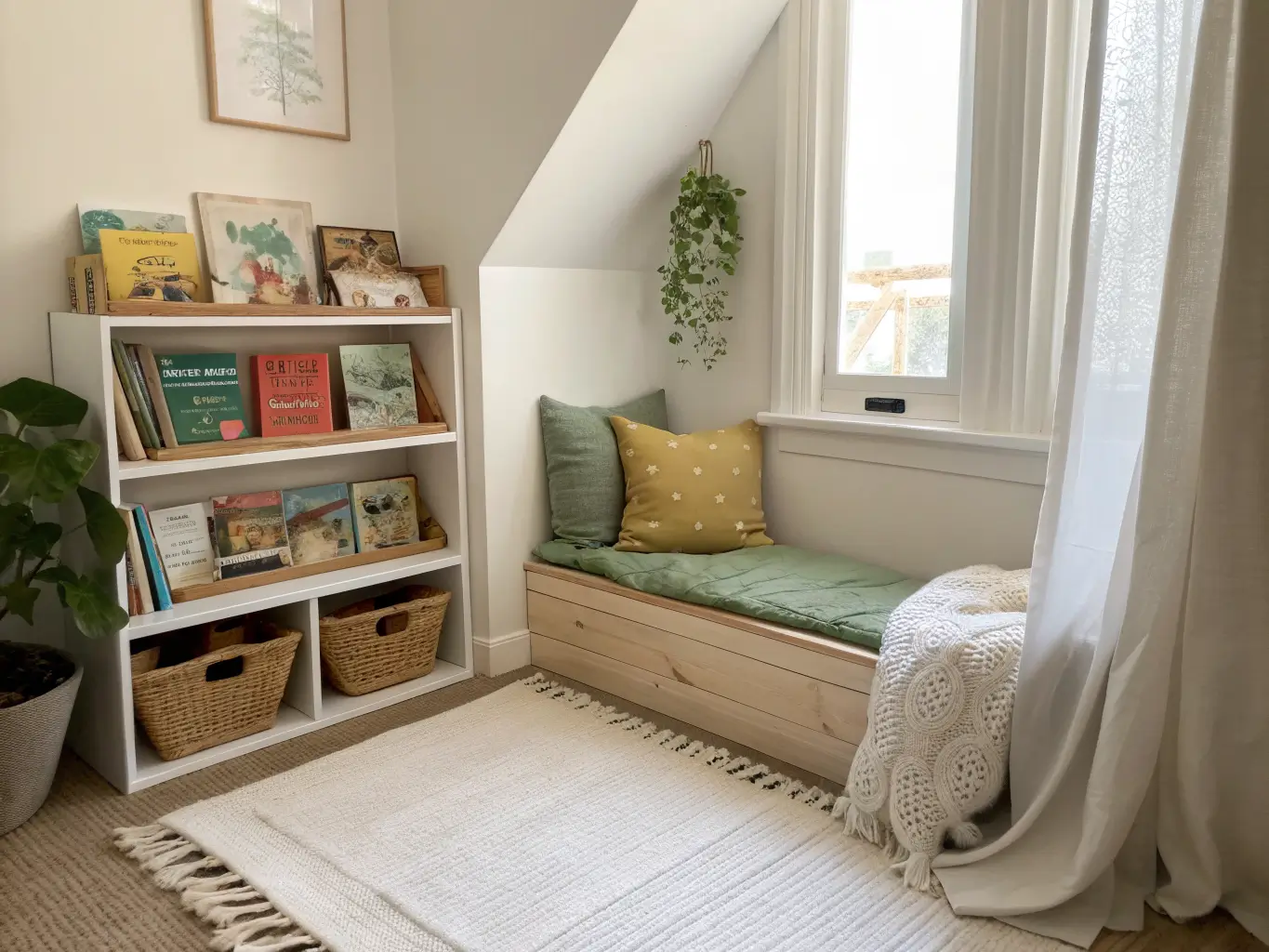
Colors and materials that work: warm neutrals — white, cream, beige, light oak or birch wood — with maybe one or two accent colors like sage green, sky blue, or mustard. Natural wood shelves, canvas baskets, cotton throws, and a washable rug do more work than anything plastic or overly “cute.” My rule after getting it wrong once: if it looks busy in the store, it’ll look chaotic in a 4-foot corner.
Who it’s for: toddlers and preschoolers, roughly ages 1 to 5, who are starting to want independence — picking their own book, sitting down without help, “reading” to themselves even if it’s just flipping pages and narrating from memory.
Where it goes: a bedroom corner, a spot in the playroom, under a window, or even a quiet edge of the living room. You genuinely only need a 3-to-4-foot corner. Mine is tucked into an alcove next to a bookshelf that used to just hold adult paperbacks nobody read.
Time, Cost, and Skill Level — Set Expectations First
– Time: A simple version (basket, cushion, a handful of books) takes 1–3 hours. A built-out nook with wall shelves, a bench, or a tent takes half a day to a full weekend, mostly due to mounting and assembly.
– Cost: Basic setup runs $30–$100. Add a low shelf, a beanbag, and a rug and you’re at $100–$300. Go bigger with a reading bench, cubbies, or a play tent and you’re looking at $300–$600+.
– Skill level: Baskets and floor cushions are beginner-friendly — anyone can do this in an afternoon. Wall-mounted ledges need basic tools and a stud finder (intermediate). Built-ins or anchored benches are intermediate-to-expert territory; I’d hire this part out unless you’re comfortable with a level and wall anchors.
Spend where your kid touches it daily — books, seating, the basket. Save on wall art and “extras.” I bought a $45 wooden name sign that said “Reading Hut” and it sat in a drawer for six months before I finally hung it. Cute, but it did nothing for how often the nook got used.
The Must-Have Pieces
You need five things. That’s it.
– Low, accessible book storage. Front-facing wall ledges, a shallow shelf, or a wide, low basket. The book covers need to face out — toddlers recognize books by cover art, not spines, and a wall of spines just looks like clutter to them.
– Comfortable seating. A floor pillow, a beanbag, a kid-sized chair, or a small padded bench. Skip anything that requires them to climb up — the whole point is low effort to sit down.
– A soft base layer. A small rug or a stack of cushions to visually define the space, even without walls or furniture boundaries.
– A short stack of books. Sturdy board books, not paperbacks that’ll get torn in a week.
– Decent light. Natural light from a window is best. If not, a warm-toned lamp (soft white, not daylight-blue LED) placed where it can’t get knocked over or grabbed.
Everything past this — the tent, the fairy lights, the wall decals — is optional. Nice, but optional.
How Many Books Should Actually Be Out
This is the mistake I made first and the one I see most. Put out 5 to 7 books at a time. Some sources say up to 10–12 is fine if the space stays tidy, but for a toddler under 3, fewer is genuinely better — it’s not about deprivation, it’s about decision fatigue. A toddler staring down 40 books doesn’t pick one, they pull all of them onto the floor and walk away. A toddler looking at 6 books, covers facing out, actually chooses one.
Rotate the stack every week or two. Keep the rest in a closet bin, not in the nook. This alone fixed 80% of my clutter problem.
Putting It Together: Layout and Order of Operations
Build it in this order, not all at once:
1. Pick the spot first. Away from the TV, away from the main toy pile, away from foot traffic. My first attempt failed partly because it was three feet from her toy kitchen — she’d get distracted mid-book every time.
2. Place the seating. This anchors the whole nook. Everything else gets arranged around it.
3. Add the book storage within arm’s reach — meaning her reach, not yours. I measured my daughter’s standing reach at the time (about 24 inches off the floor) and mounted the ledge there, not at a height that looked balanced to my adult eye.
4. Layer in the rug, blanket, and a stuffed animal or two. This is what makes it feel like a place, not just a shelf with a pillow near it.
5. Add one visual anchor last — a small tent, a canopy, or a piece of wall art. One feature, not three. This is where nooks start looking like a garage sale of good intentions.
Texture layering matters more than decor. Rug, cushion, knit throw, plush toy — that combination does more to make a corner feel cozy than any wall sign or string of lights ever will.
Common Mistakes (I’ve Made Most of These)
– Too many books on display. Covered above — it’s the single biggest culprit behind an unused nook.
– Storage that’s too high. If your toddler needs you to get a book, it’s not their reading nook, it’s yours.
– All style, no comfort. A beautifully arranged shelf next to a hard, cold floor won’t get sat in. Comfortable seating isn’t optional.
– Bad lighting. A dim corner might look moody in photos but it’s useless for actual reading and mildly discourages the whole point of the space.
– Toy creep. If the nook slowly fills up with cars and blocks because it’s the nearest flat surface, it stops being a reading spot. I keep a hard line: books and stuffed animals only, nothing with wheels.
– Torn or damp board books stay in rotation too long. Toss or repair them. A ratty book signals “this space isn’t cared for,” even to a two-year-old on some subconscious level.
– Unsecured decor. String lights within grabbing distance, a tent frame that tips, a wall shelf that’s not anchored to a stud — all real hazards. I re-mounted my ledge after the first one, installed with drywall anchors alone, wiggled loose within a month.
Keeping It Fresh Without Buying New Furniture
You don’t need to redo the whole nook every season. Small swaps keep it feeling current:
– New pillow cover ($8–$15) instead of a new pillow.
– Thrifted basket swapped in for the plastic bin — I found a woven seagrass one for $6 that instantly made the corner look intentional instead of like overflow storage.
– Rotate in 2–3 seasonal books — a pumpkin book in October, a book about snow in January — without touching anything else.
– Free printable alphabet art taped up instead of a $60 framed print.
As your kid grows, the nook should evolve with them. The floor cushion that worked at 18 months can become a small chair by age 4. Keep the book display low regardless of what the seating becomes — that’s the one detail that shouldn’t change just because your toddler got taller.
– Modern: white floating shelves, clean cubby storage, sage or sand accent color.
– Montessori: just a low wood shelf, a short book rotation, and open floor space — no bench, no tent, nothing extra.
None of these need to be expensive to work. The nook that finally stuck in my house cost under $70 total — a $25 IKEA book ledge, a $20 rug remnant, a $15 floor cushion, and books we already owned. The tent and the fairy lights I’d originally splurged on are in a closet somewhere. Turns out my kid just wanted somewhere low, soft, and hers.
For another angle on this, my kids study room ideas guide covers the same space from a different starting point.