Forget the idea that this has to be some iconic design-magazine piece. A reading nook chair today usually means one of these: a deep upholstered accent chair, a swivel chair, a barrel chair, a chair-and-ottoman set, or an oversized lounge seat. Comfort comes first. Style is the tiebreaker.
Right now the fabrics people actually want are bouclé, corduroy, velvet, faux fur, and chenille — soft, textured, forgiving materials that hide crumbs and look intentional even when your throw blanket is half-falling off the arm. Swivel bases are having a moment too, along with oversized seats for people who want to curl up, and compact chairs for anyone working with a tight corner.
Who this is for: apartment dwellers who need one chair to do a lot of work, anyone craving a dedicated unwind spot that isn’t the couch, and people who want a corner that feels finished, not just furnished.
Where it works: bedrooms, living rooms, home offices, window nooks, guest rooms. Basically any spot with a wall, a little floor space, and decent light — natural or otherwise.
Quick style snapshot before you shop
Time to set up: 1–3 hours for a simple chair-plus-lamp corner. Budget half a day if you’re assembling furniture, running a new lamp, and layering in decor.
Cost range: $40–$90 for an oversized memory-foam bean bag, under $60 for a floor-cushion setup, $150–$300 for the real comfort-and-quality sweet spot, $400+ for a statement chair. (An actual Eames Lounge chair is its own category — that’s a $6,000+ conversation, not a reading-nook budget.)
Space needed: as little as a 24-inch-wide corner for a slipper chair, though most chair types want a 30–56 inch footprint depending on style.
Skill level: beginner if you’re just placing a chair and a lamp. Intermediate if you’re mounting a hammock chair or building out a bench-style nook with storage.
Seasonality: year-round. You’re not swapping the chair with the seasons — you’re swapping what’s on it.
The chair shape decides everything else
I made the mistake of buying a wingback chair for a corner that was 26 inches wide. It looked stately in the store. In my apartment it ate the whole nook and stuck out so far I had to walk around it to open the closet. Measure the actual space before you fall for a chair online.
Match the chair to how you really sit, not how you imagine you’ll sit:
– Swivel or barrel chair — best if you want flexibility, want to turn toward a window or turn back toward the room. Also reads more modern.
– Wingback or high-back — good if you read with your head against something, or if you get cold and want the wings blocking a draft.
– Club chair with ottoman — the classic choice, and genuinely the most comfortable for long sessions because your legs are supported instead of dangling.
– Slipper chair — no arms, smaller frame, the move for a tight corner where a bulky chair would dominate the room.
– Bean bag or oversized floor seat — cheapest entry point, and honestly great for anyone who reads cross-legged rather than upright.
The single biggest mistake people make: buying a chair that looks good in a product photo but is too deep, too wide, or too rigid for an actual hour of reading. A chair can be gorgeous and still be a bad reading chair if there’s no lower-back support. I learned this the hard way with a barrel chair that looked perfect and left me shifting every ten minutes because the seat back curved wrong for my spine. Sit-test if you can, or at minimum read the return policy before you buy anything upholstered and firm.
The pieces that turn “a chair” into “a nook”
A chair alone in a corner just looks like a chair someone forgot to move. What makes it read as an actual reading nook:
– A support piece — small ottoman or footstool, especially if you’re settling in for real reading sessions and not just five minutes with a magazine.
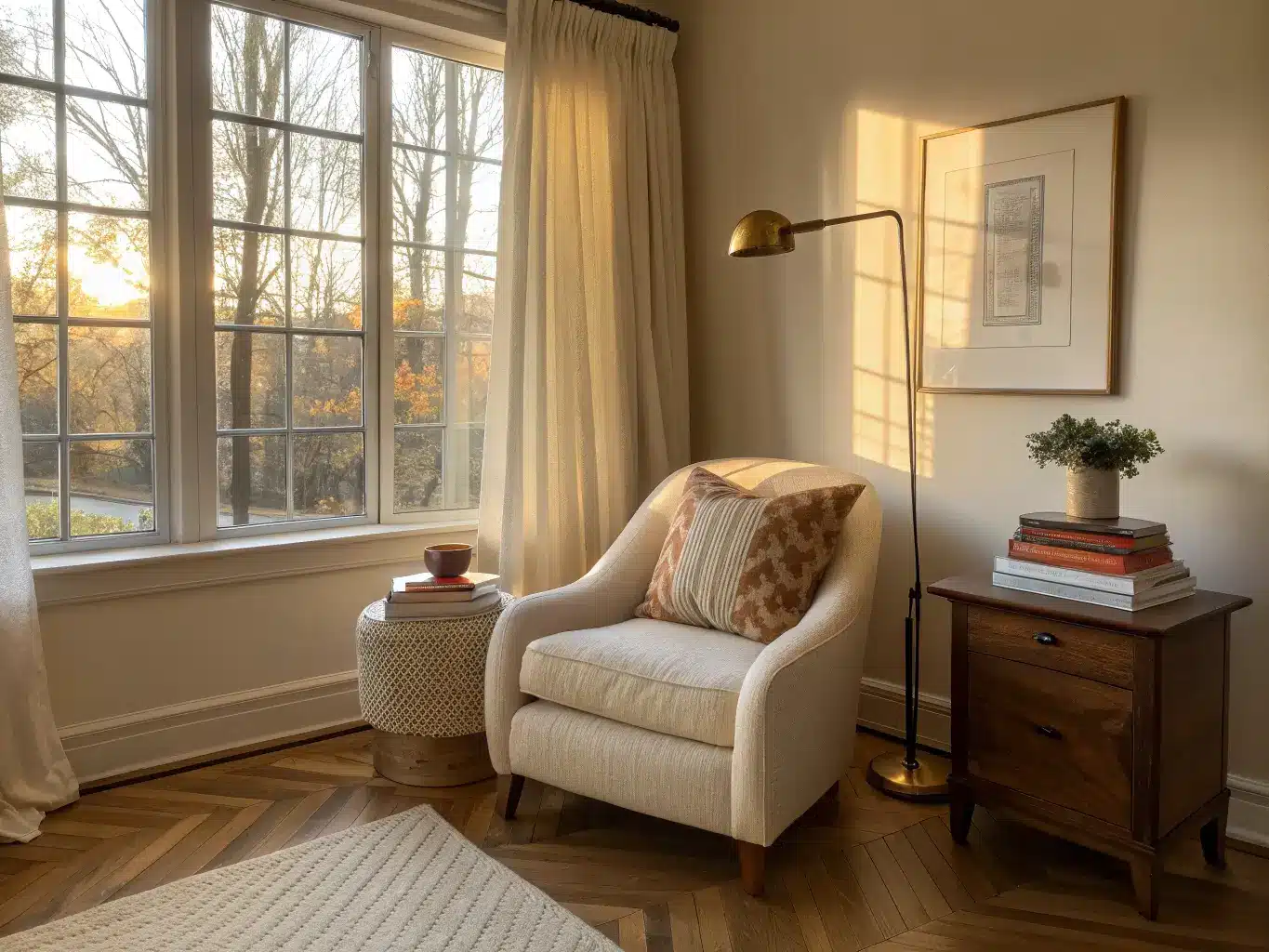
– Lighting — a floor lamp or task lamp aimed at page height. This is the piece people skip and then wonder why the corner never gets used after 6 pm.
– A side table — round, small, just big enough for a book, a mug, glasses, maybe a candle.
– Soft layers — one throw blanket, one lumbar pillow, one or two accent cushions. Stop there.
– Something on the wall — art, a mirror, even a small print. This is what makes the corner feel decided rather than accidental.
– A basket or small stack for current reads, so books aren’t sliding off the side table by day three.
I keep coming back to this trio: lamp + side table + wall art. If those three things are in place, the chair reads as a nook. Skip any of them and it just reads as “a chair someone put in the corner.”
Building the look, step by step
1. Place the chair first. Everything else gets arranged around it, not the other way around.
2. Add the side table within arm’s reach — you shouldn’t have to lean to grab your mug.
3. Position the lamp at shoulder height or just behind your dominant reading side, so the light falls on the page and not in your eyes.
4. Bring in one storage solution — basket, small shelf, whatever fits the space — for books in rotation.
5. Add soft layers last. Throw, one or two pillows. Resist the urge to keep adding “just one more.”
If the nook’s in a bedroom, I’d keep the palette soft and muted — this is not the spot for a bold contrast chair. If it’s in the living room, echo whatever wood tone or upholstery color is already dominant in the room so the corner doesn’t look like it wandered in from a different house.
Color, material, and not overdoing it
Popular tones right now: cream, ivory, oatmeal, taupe, warm gray, camel, chocolate brown, forest green, dusty blue, with black as an accent. Materials showing up everywhere: bouclé, velvet, corduroy, chenille, top-grain leather, faux fur.
My rule, learned by doing it wrong first: two to three textures, max. My first nook attempt had a bouclé chair, a knit throw, a faux fur pillow, a jute rug, AND a woven basket. It looked like a texture sample board, not a room. Now I stick to something like bouclé + wood + metal, or corduroy + linen + brass, and stop there.
Same logic on color — one dominant color family, one contrast tone. Cream chair, walnut side table, black lamp. Or camel leather chair with ivory textile layers. Pick your two and don’t keep adding “just one more accent color.”
Common mistakes, all of which I’ve made
– Buying too bulky for the space. In a compact room, 24–30 inches might be your real ceiling. Measure twice.
– No back support. A soft seat isn’t the same as a supportive one. Your lower back will tell you the difference after 40 minutes, not immediately in the showroom.
– Skipping the lamp. A beautiful chair with only overhead light or window light is a beautiful chair you’ll stop using once it gets dark at 5 pm.
– Overstyling. Too many pillows, too many baskets, too many decorative objects turns a quiet retreat into visual noise. If you can’t see the chair’s actual shape under the styling, pull two things back off.
– Ignoring the corner itself. A gorgeous chair in a cluttered, ill-lit corner still feels like an afterthought. Clear the space before you even start arranging.
Budget: where to spend, where to save
– Under $60: floor cushions or a basic setup — smart if you’re not sure this corner will actually get used, or you’re testing the layout before committing.
– $40–$90: oversized memory-foam bean bag — surprisingly comfortable, and forgiving if you change your mind about the room later.
– $150–$300: the real sweet spot. Better frames, denser foam, upholstery that holds up. This is where I’d tell most people to land if they’re buying with any intention of keeping the chair long-term.
– $400+: premium statement chairs — worth it if this is a piece you want to keep for a decade, or if it’s doing double duty as the visual anchor of the room.
Start cheap if you’re unsure the nook will stick. I did the bean bag route in my first apartment for about eight months before I was confident enough in the layout to invest in an actual chair. No regrets — it told me exactly how I use the space before I spent real money.
Keeping it fresh without redoing the whole thing
– Swap pillow covers and throws by season — heavier velvet and faux fur in winter, lighter linen-look textiles in summer.
– Change your bulb temperature — warmer light in winter, cooler in summer, same lamp.
– Add a plant or a wood tray to soften an all-upholstery corner. A single potted plant in the dead space beside the chair does more work than another pillow.
– Modern + cozy — swivel bouclé chair, black side table, one sculptural lamp.
– Traditional + luxe — wingback chair, plaid or velvet pillow, brass lamp, wood bookcase behind it.
The chairs getting the most attention right now — swivel accent chairs, bouclé chairs, oversized chenille seats, compact upholstered chairs for small rooms — aren’t trendy for no reason. They solve the actual problem: comfort in a shape that doesn’t take over the room. That’s the whole assignment. Pick the shape that fits your corner and how you actually sit, add the lamp, and stop before you overstyle it.
For another angle on this, my cozy reading nook guide covers the same space from a different starting point.