If you’ve typed “how do I make my home office look feminine without it looking like a teenager’s bedroom” into Google, I’ve been exactly where you are.
My first attempt at a “girly” office involved a blush pink accent wall, a fuzzy white rug, and a gold-framed mirror I bought on clearance — and the whole room read like a Pinterest board that never grew up. It took me two full redos to figure out that a feminine home office isn’t about how much pink you use. It’s about restraint, contrast, and a few pieces that actually work as hard as you do.
Here’s everything I learned turning a spare bedroom into a workspace that looks polished on a video call and still functions when I have four browser tabs open and a deadline in twenty minutes.
Quick Style Snapshot
Time needed: A simple refresh — new lamp, art swap, rug — takes a single afternoon. If you’re painting, wallpapering an accent wall, or assembling storage furniture, block off 2 to 4 days, because flat-pack cabinets always take longer than the box promises.
Budget: I’ve done versions of this room for $250 (thrifted desk, spray-painted hardware, one great lamp) and versions closer to $2,500 (custom desk, upholstered chair, wallpaper, new lighting). Most people land in the $600–$1,200 range if they’re buying one statement piece — usually the desk or chair — and styling around it.
Space size: This works in a corner nook, a converted guest room, a loft landing, or a full spare room. I’ve set one up in a 6-foot-wide alcove and another in a 12×14 bedroom. The principles don’t change, just the scale of what you buy.
Skill level: Styling is beginner-friendly. Add paint, wallpaper, or floating shelves and you’re in intermediate territory — nothing you can’t handle with a level and a Saturday.
Seasonal appeal: Year-round. You’re not redecorating the whole room each season, just swapping textiles, flowers, or a throw pillow.
The Look: Feminine, Not Fussy
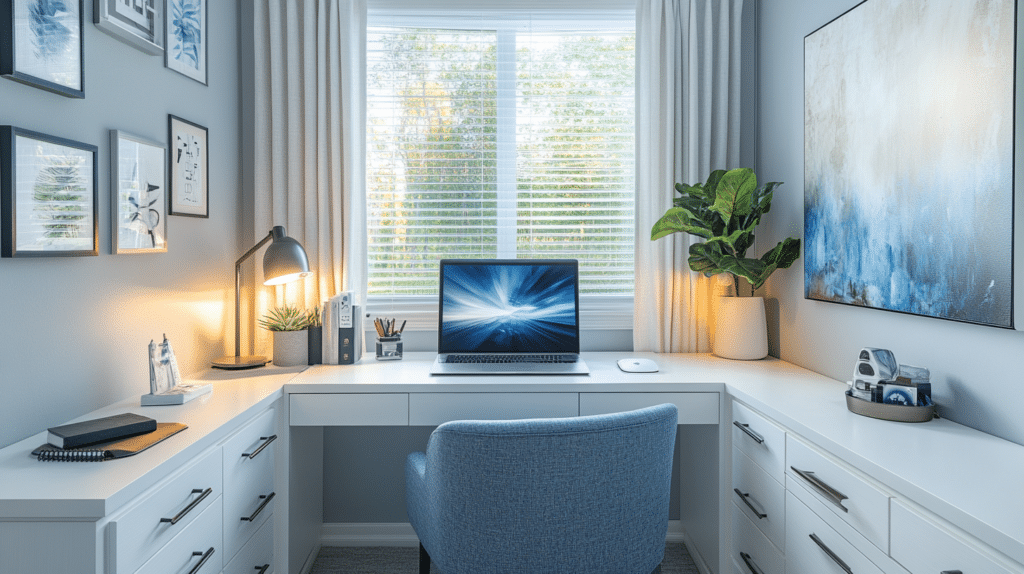
The style I’m describing sits somewhere between feminine glam, soft modern, and what I’d call comfy luxe — polished enough for a client call, comfortable enough for a six-hour writing day. Think blush pink, dusty rose, cream, ivory, charcoal, navy, soft blue, and gold, built on materials like velvet, brass, glass, lacquered wood, and a plush wool or wool-blend rug.
This is for women working from home who want a space that feels like theirs — not a beige cubicle transplant, not a little girl’s dress-up corner. Entrepreneurs, consultants, therapists doing virtual sessions, anyone whose desk shows up on camera — this look photographs well without trying too hard.
It works in a dedicated office, a guest room doing double duty, or even a sitting room you’re willing to give up. I’ve also seen it done beautifully in a closet-turned-nook with just a floating desk and one great wall.
Key Pieces That Make It Work
The desk is your anchor — choose it first
Everything else gets built around this piece, so don’t rush it.
– Creamy lacquered desk — reads expensive, hides less than glass, easy to wipe down
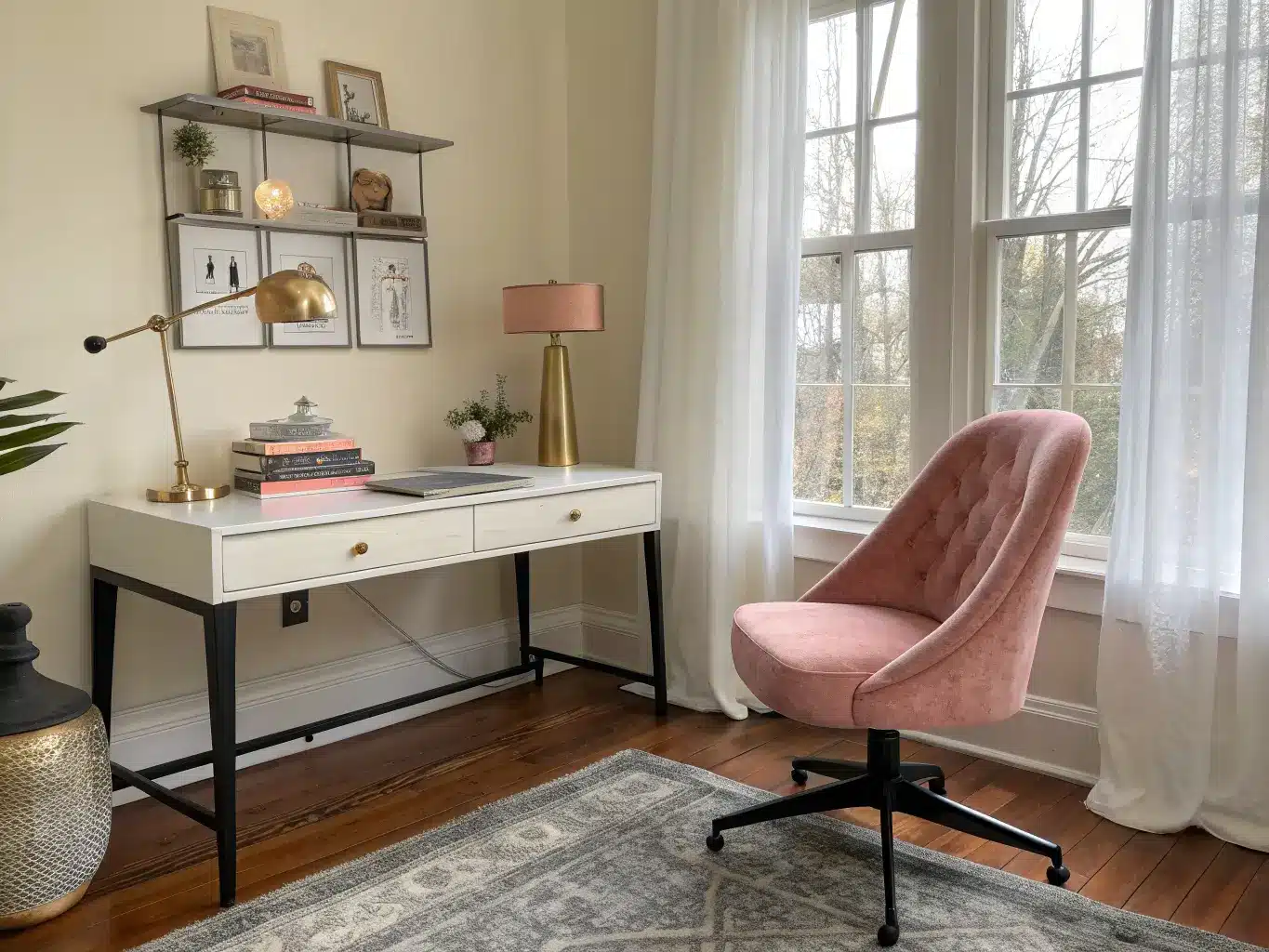
– White desk with gold hardware — the most versatile option, works with almost any accent color
– Light wood desk (oak or ash tone) — softens the room if you’re going heavy on white and pastel elsewhere
– Glass-top desk — visually lightens a small room but shows every fingerprint and cord; I regretted mine within a month
– Pink-painted statement desk — bold, works only if everything else in the room stays neutral
My honest take: skip glass unless you’re disciplined about clutter. I switched mine out for a cream lacquer desk from a secondhand marketplace, painted the legs matte black, and it instantly looked more expensive than the glass one I’d paid three times as much for.
The chair has to earn its keep
A pretty chair that hurts your back after an hour is a bad trade. Options that balance both:
– Velvet desk chair with a swivel base — my current pick, dusty rose velvet with brass legs
– Upholstered ergonomic chair — worth the extra $150–$200 if you’re in it 6+ hours a day
– Blush ergonomic chair — a newer category, more brands are making these now, usually $200–$400
– Chic accent chair — fine only if this office is more display than daily grind
Lighting and storage aren’t optional extras
– A gold or brass desk lamp does more to make a room feel finished than almost anything else you’ll buy
– If the room lacks windows or gets weak light, use full-spectrum daylight bulbs (around 5000K) — this matters more than any decor choice if you’re on camera often
– Vertical file organizers, closed cabinets, or a small credenza keep the desktop clear — visible storage should be curated, not a catch-all
How to Put It Together
Start with the biggest pieces first: desk, chair, storage, rug. Everything else layers on top.
Place the desk with intention. My biggest early mistake was shoving the desk flat against the wall because that’s what you do with furniture, right? Wrong, if the room allows otherwise. Pulling the desk out — even 18 inches — so it faces into the room or sits at an angle instantly made the office feel designed instead of default. If your room is small, at least try to face the desk toward the window rather than a blank wall.
Pick one focal point behind the desk. This is what shows up on every video call, so make it count: a large framed print, a small gallery wall, open shelving, or a wallpapered panel. I used a peel-and-stick wallpaper in a soft botanical print on just the wall behind my desk — cost me $45 and did more visual work than anything else in the room.
Build your palette around a neutral base. White, ivory, or a warm beige on the walls and big furniture. Then let 2–4 accent tones carry the personality — in my room that’s blush, brass, and charcoal. Nothing else gets in.
Mix soft textures against clean lines. A velvet chair against a lacquered desk. A plush rug under sharp black picture frames. This contrast is the actual answer to “how do I make this feminine without it looking childish” — softness needs something structured to lean against, or it just reads sweet and undefined.
Layer in the small stuff last: a tray for catching mail, one ceramic vase, a small stack of books, a framed photo. Resist adding a fourth decorative object. One tray, one lamp, one vase — that’s the rule I use now after learning the hard way that “more pretty things” doesn’t equal “more pretty room.”
Budget: Where to Spend, Where to Save
Spend on:
– The chair, if you’re in it daily — this is not where to cut corners
– One quality lamp — cheap lamps look cheap in a way nothing else in the room can hide
– The rug, if the room has hard flooring — it anchors the whole layout
Save on:
– Desk accessories (trays, organizers, small boxes) — HomeGoods, Target, and thrift stores all have great options
– Wall art — a $30 print in a $15 frame from a big-box store looks identical to something triple the price once it’s framed and hung
– Hardware swaps — a $12 pack of gold drawer pulls transformed a $40 secondhand desk into something that looked custom
Common Mistakes to Avoid
– Desk flat against the wall by default. Pull it out or angle it if you have even a little room to work with.
– Choosing pretty over functional. No task lighting, nowhere to file papers, a chair that’s cute but unsupportive — you’ll abandon the styled look within a month out of sheer discomfort.
– Too much pink, no contrast. Pink needs black, charcoal, or navy nearby or the whole room goes flat and one-note. This was my first-attempt mistake exactly.
– Visible cords and printer cables. Nothing undercuts a styled office faster. A $20 cord sleeve or a cabinet with a cutout for cables solves this in ten minutes.
– Decorating every wall. One strong focal wall beats four walls each doing a little something. Let the rest breathe.
Keeping It Fresh Without Redoing the Whole Room
Stick to your cohesive tones and repeat one or two accent finishes — I use brass and black throughout mine, nothing else — so new additions always feel like they belong.
Seasonal swaps that take twenty minutes:
– Spring: fresh tulips or ranunculus in a small vase
– Summer: swap in a linen or cotton throw pillow, lighter textiles overall
– Fall: richer tones — a rust or terracotta accent pillow, dried pampas grass instead of fresh stems
– Winter: a chunky knit throw on the chair, warmer bulb tone in the lamp
Budget refreshes:
a new lamp, a peel-and-stick wallpaper panel, swapping one framed print, a new rug runner under the desk. Any one of these can make the room feel new for under $100.
Cross-style variations
if you want to push the look further:
– Boho-feminine: add rattan trays, a jute rug layered under a smaller pink one, dried florals
– Glam-modern: lean into gold and black, mirrored surfaces, a lacquered black desk instead of white
– Coastal-feminine: swap blush for soft blue, add sand and white tones, woven textures instead of velvet
If the room ever starts feeling too soft or too sweet, sharpen it with black picture frames or a darker rug. If it feels too stiff or corporate, that’s your cue to add the velvet chair or the plush rug you’ve been putting off. The room should shift a little as you do — that’s the whole point of decorating a space you actually work in every day, not just photograph once and forget.
For another angle on this, my his and her office space guide covers the same space from a different starting point.