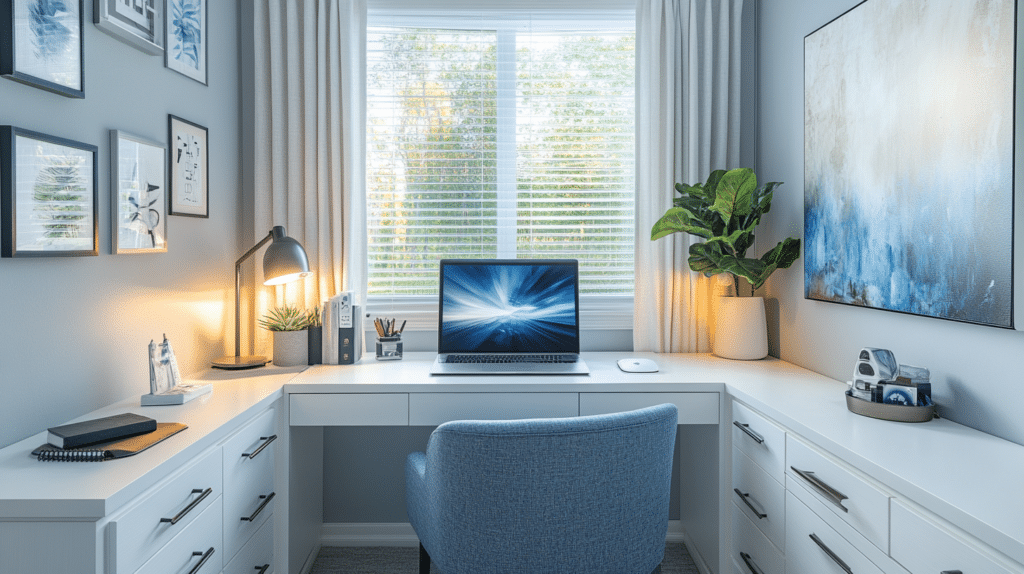
My study nook used to be a folding table shoved against a bare wall with a clip-on lamp from a college dorm. It worked, technically. I sat there. I typed things. But I dreaded going near it, and I’d take my laptop to the couch out of pure avoidance — which defeats the whole point of having a dedicated spot to focus. A cozy study room fixes that problem: it’s a workspace that makes you want to sit down, not one you tolerate.
The trick is that “cozy” and “functional” pull against each other if you’re not careful. Throw pillows don’t help you read a spreadsheet. A gorgeous velvet chair with zero lumbar support will wreck your back by week two. This is the balance I’ve landed on after redoing my own corner three separate times.
What This Style Actually Is
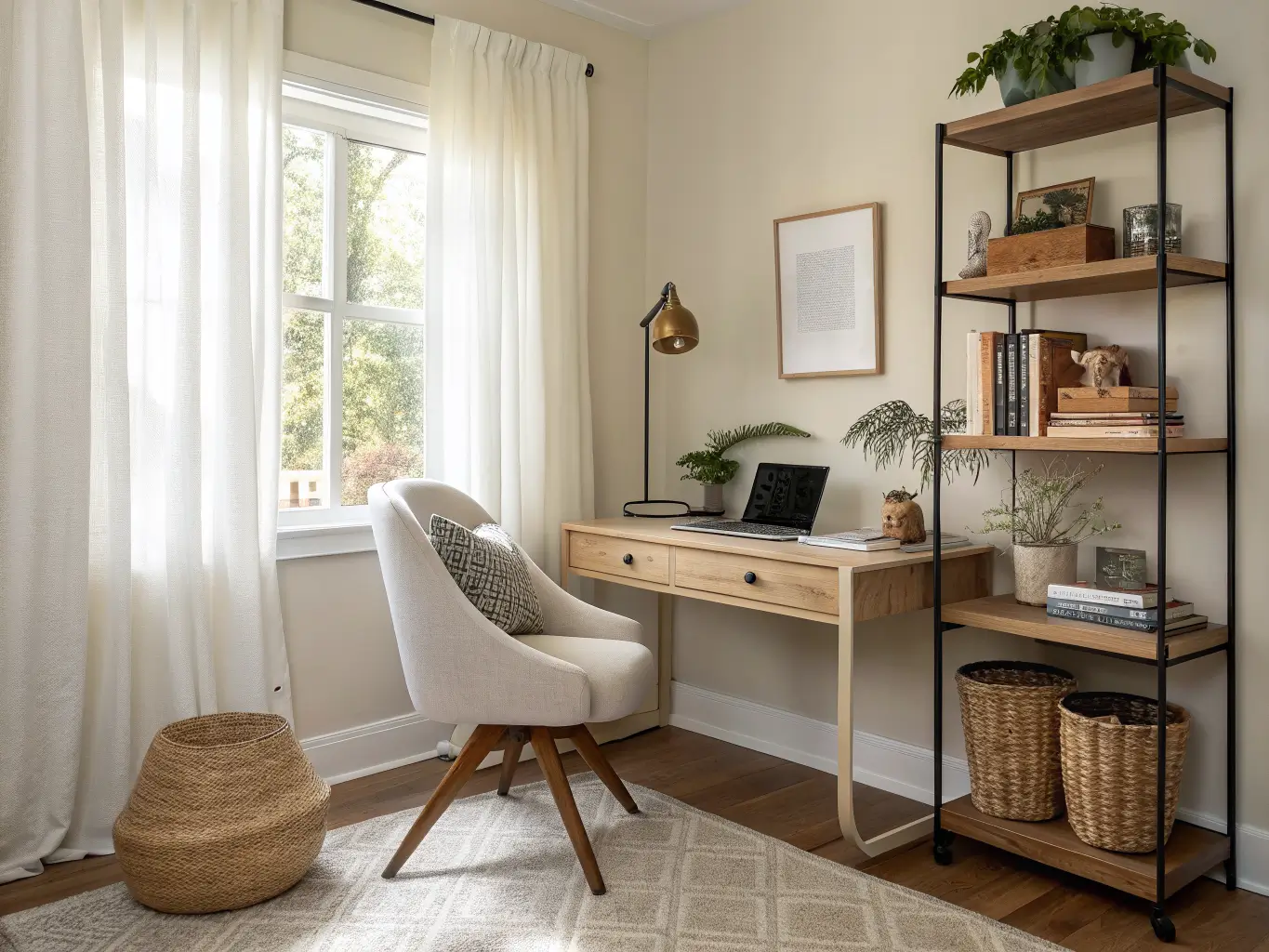
Think of it as cozy minimalist meets hygge, with the option to lean boho, Scandinavian, or cottage depending on your accessories. The bones stay warm and simple — natural wood, soft textiles, warm-white light — and you layer personality on top with plants, art, and texture.
Color palette that works:
– Base neutrals: beige, cream, warm white, light gray
– Accent tones (pick one or two, not five): sage green, dusty blue, soft blush, forest green
– Materials: natural wood, rattan, linen, chunky knit throws, cork, woven jute
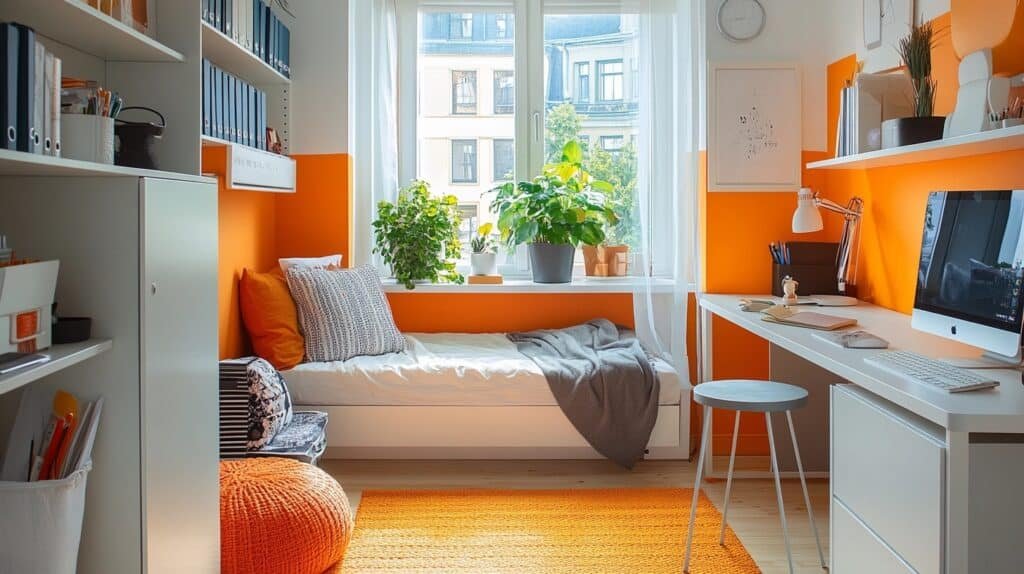
This look is built for students, remote workers, and anyone reading or working from a bedroom corner, dorm room, or living-room nook. You don’t need a spare bedroom. I’ve made this work in a 3-foot-deep alcove next to a window, and I’ve seen it done just as well under a staircase.
Setup Time and Real Costs
A simple refresh — new lamp, a throw, a rug, some desk organizers — takes 1 to 3 days and runs $150–$400. If you’re painting, adding floating shelves, or swapping out window treatments, budget 1–2 weeks and $500–$1,500+, especially once an ergonomic chair enters the picture (those alone can run $200–$600 if you buy a decent one).
Where to spend, where to save:
– Spend on the chair. This is the one place I regret cheaping out. I bought a $60 accent chair because it looked good in photos, and I was standing up every 20 minutes to stretch my back. Replaced it with a $220 ergonomic chair with actual lumbar support and my focus time doubled — not an exaggeration, I use a timer app.
– Spend on layered lighting. One nice lamp isn’t enough.
– Save on decor objects. Trays, baskets, art prints — thrift these or buy secondhand. My favorite piece on my shelf is a $4 ceramic dish from a church rummage sale.
– Save on the rug if it’s a small footprint — a 3×5 doesn’t need to be expensive wool.
Must-Have Pieces for a Cozy Study Room
The desk. In small spaces, go with a wall-mounted or floating desk — anything that doesn’t eat floor space. I use a 40-inch floating desk in my nook and it fits a laptop, a lamp, and a plant with room to spare.
The chair. Ergonomic first, cozy second. If you want softness, add a sheepskin seat pad or a low-profile cushion rather than sacrificing support for style.
Task lighting plus ambient lighting. This is non-negotiable. One warm-white desk lamp (look for 2700K–3000K bulbs — anything higher reads cold and clinical) for actual work, plus a secondary light source — a small floor lamp or wall sconce — so the room doesn’t feel like an interrogation room after dark.
A small rug. In tight nooks, a 3×5 or 4×6 grounds the space without overwhelming it. Wool or a wool-blend feels warmer underfoot than a flat-weave cotton one.
Storage that’s actually used. Floating shelves above the desk, a couple of woven baskets underneath, a corkboard or magnetic board for loose papers. Without this, cozy turns into cluttered in about a week — I know because it happened to me twice before I added a single shelf with three baskets and suddenly the whole desk looked intentional again.
Personal touches. Framed art, a small stack of books, one or two photos. This is what makes a study nook feel like yours instead of a furniture showroom.
Optional Layers That Elevate the Look
– Plants: a pothos on the shelf, a small snake plant on the desk corner, or if you have floor space, something taller like a 3-foot fiddle-leaf fig
– String lights tucked along a shelf edge for ambient glow in the evening
– Natural textures: a jute rug, linen curtains, a reclaimed wood shelf
– Slightly luxe touches: a brushed brass lamp base, a faux fur throw over the chair arm, ceramic desk trays instead of plastic ones
– Candles or a reed diffuser — I keep a cedar-scented candle near my desk for evening study sessions; it’s a small thing but it signals “settle in” to my brain
How to Actually Put It Together
Step 1: Prep the space. Pick the quietest corner with the most natural light you can manage. Measure before you buy anything — I’ve bought a desk that was two inches too deep for my alcove and had to return it, which taught me to measure twice and screenshot the dimensions before checkout.
Step 2: Place the big pieces first. Desk, then chair, then shelving. Don’t add a single decorative object until these three are settled and you can move through the space without bumping into anything.
Step 3: Layer your lighting. Task lamp on the desk, ambient light source somewhere else in the room — a floor lamp in the corner, a plug-in wall sconce, whatever fits. Turn off the overhead light and test both sources together before you call it done.
Step 4: Add softness. Rug down, throw over the chair, a cushion if your seat needs one. This is the step that takes a workspace from sterile to lived-in.
Step 5: Finish with objects that matter. A plant, a couple of books you’re actually reading, one tray to catch loose items. Stop there. This is the step where most people overdo it.
Small-space rule: if your footprint is under 20 square feet, go vertical. Wall shelves and pegboards do the work that floor furniture can’t.
Mistakes I’ve Made (So You Don’t Have To)
– Overloading the shelf. My first version had books, three plants, a candle, two picture frames, and a decorative bowl on a single 30-inch shelf. It looked like a garage sale. I cut it down to one plant, a small stack of books, and one frame — instantly calmer.
– One lamp, no backup. Working under a single warm lamp at night strains your eyes faster than you’d think. Layer it.
– Choosing looks over support. Covered this above, but it’s worth repeating: an uncomfortable chair undoes the whole project.
– No system for cables and clutter. Buy a $12 cable clip and a couple of trays before you buy any more decor. Loose cords under a “cozy” desk just look messy, not warm.
– Going all-gray. A gray desk, gray chair, gray rug — it reads flat and a little cold no matter how many candles you light. Warm the palette up with at least one wood tone and one soft accent color.
Keeping It Looking Good Long-Term
Stick to 2–4 colors total and repeat your materials — if you’ve got a wood desk, echo that tone somewhere else, like a wicker basket or a wood-framed print. Edit your desktop weekly; five minutes of clearing loose papers keeps the whole setup from sliding back into clutter.
You don’t need to buy new furniture to refresh the room. A $15 new lamp shade or a $20 pillow cover changes the whole feel for less than a dinner out.
If you want it to feel more current, mix in one tactile trend piece — a boucle cushion, a ribbed ceramic vase, a faux fur throw — against your clean-lined storage. That contrast between structured and soft is what keeps a cozy study room from looking like a themed stage set.
For another angle on this, my study room decor guide covers the same space from a different starting point.